Thursday, 11 October 2012

Night Photography - Part 1

Waiting for a bite at night
 
Getting Creative in the Dark
Most people put their cameras away when out fishing once the sun goes down unless taking happy snaps of a significant catch. I too was mostly guilty of this in the past. I had made a few attempts once or twice at getting an interesting shot at night, and have had varied success. On an overnight trip to the bottom of South Australia's Yorke Peninsula last weekend, I carried a tripod in to shoot some wide angle landscapes. When I opened my camera bag, to my horror I discovered that in my haste I had not swapped the len which was on my 7D over for the wide angle zoom. Instead of having a 17-40mm and 70-200mm with me, I had no focal length shorter than the Sigma 50mm f1.4 which was on the camera body. The 50mm focal length is considered a "normal" lens on 35mm film and full frame digital. As the 7D has a cropped frame sensor, the lens angle of view gives a short telephoto perspective, and was therefore useless for the types of images I had in mind. I did shoot a few frames of the cliffs that you can see in the image above as the sun was setting, however my efforts were a little rushed and half hearted as I did not have the lens I had planned to use.
 
Since I had carried the tripod in, I figured I had better get more than a few minutes use from it, so after the sun set, the sky darkened, and the cloud cover mostly disappeared to reveal the stars; out came the camera again. Using the tripod, a slow shutter speed, and the fast aperture of the 50mm f1.4 lens, I did my best to roughly compose through the viewfinder (no preview image was available on the cameras LCD screen in liveview mode as it was much too dark). I then turned on liveview and used the electronic level to try and get the horizon relatively straight. I made a number of images using this and similar techniques. I am the first to admit they could be improved, but for me this was a whole new idea. In Part 2 I will go through how I went about experimenting that night, and will share a few more images that were created as a result. 

Saturday, 29 September 2012

Back to it on Grand Final Day!

Goal Posts

Firstly I would like to apologise for the lengthy delay in this post, and of course the lack of posts over the last 6 months. To those who know me personally, you will understand I have had other things that needed dealing with in my personal life. To those who don't, I greatly appreciate your patience - Thank you all.

My Australian readers will know that it is AFL Grand Final Day today. As I type this, the vast majority will most likely be watching the big game. Not me though, it has never really been my thing. So this seems as good a time as ever to get back to what is important to me - the Flywater Exposed project!

I know from what I have been told that some of you had been eagerly awaiting part 2 of The Perfect Camera System. It is in the works and will hopefully be coming quite soon. I started writing it quite recently, and then noticed that a number of interesting new full frame cameras have been announced. Since it will be a little while until I get full details about how good they actually are, I though it may be best to hold off until I can include them in the post. I have also decided to try and push Flywater Exposed further now that I am back. I will be talking to a few local camera stores and attempting to get my hands on some of these cameras for review, and so that I can give my personal views on what I like and dislike about them. To my mind this would be much more useful both to you and to myself than me simply reporting on what other people say about these cameras.

Thanks again for your patience. A number of new posts will be up over the coming weeks. 

Tuesday, 6 March 2012

The Perfect Camera System - Part 1


As a major part of the Flywater Exposed project revolves around producing a body of high quality photography, it probably will not be a surprise to anyone that photographic equipment is an important part of what will be taken on the journey. I decided almost immediately that I would take only one system and the necessary backup gear in case of failure. I don't plan on being anywhere near a camera store, so everything will have to come with me. Selecting a system was the next step, and it made most sense to stop and think about what I need from my camera. Of course, to do this I had to think about what my actual requirements were, as opposed to what I would like.


It was important to define the necessities, the things required as a prerequisite for a camera to even be considered. I decided there were 4 things that were absolute musts. The first thing to come to mind was reliability, secondly, control,  thirdly a range of suitable lenses and accessories, and last but not least - image quality.

To me, a reliable camera for outdoor work should be built strong on a tough metal chassis and have a reasonable level of weather sealing. Straight away, this rules out all the cheaper consumer cameras except a handful of compacts, some of which are totally waterproof and highly shock proof too.


Control is the next thing which is important to me. From the time of capture, right through until the point the prints roll off the printer I must be able to control things. At capture, I like to make my own decisions on exposure, depth of field, shutter speeds and where in the image the focal point lays. Once the image makes it from the memory card to the computer, I insist on "developing" it in a RAW converter rather than have the camera do this conversion it's own way in camera. This counts out those waterproof, shockproof compacts that I mentioned above.


When it comes to image quality, what I require is enough resolution to shoot landscapes and print them at a reasonable size at exhibition quality. If I can produce a 16x24 inch print that has enough detail to keep me happy, then it will be fine. Of course a bigger print would sometimes be even better. If the camera can capture a reasonable amount of dynamic range, produces pleasing colours, and can manage shooting without flash in low light at relatively high ISO settings - then it will produce the image files I am looking for. 


Lastly, a range of lenses needs to be available that will cover all the shooting I am likely to do. The plan is to shoot a lot of landscapes, so therefore lenses that perform well from corner to corner will be highly regarded. If they have tilt and shift functionality, so much the better. As a bonus, lenses with movements allow easy stitching for making higher resolution prints. I also plan to shoot portraits of the locals, so some mid range focal lengths with fast apertures would be nice if they fit in the bag. A good macro lens is also essential for capturing some small but important details. For all of these types of shooting I prefer prime (fixed focal length) lenses. Of course as backup, and for the less critical shots that are less likely to be displayed as large exhibition prints, a few high quality zooms would definitely be worth having in the bag. A good flash system certainly wouldn't go astray either, allowing images that could not otherwise have been made to be produced.


The Ideal Camera Format
What I have decided so far is that a full frame 35mm sensor digital SLR is the camera format that makes the most sense. There are a few around with the build quality and reliability that I am after with sensors packed with high quality pixels. Of course there are also some sub full frame cameras that would work, including the Canon 7D which I currently own, however I prefer the wide angle options  afforded by the larger sensor cameras. If I was mostly shooting wildlife, that may be a different matter. 


Part 2 will focus on the nitty gritty details of selecting an actual camera from the contenders, and give some details about some of the options that are available.

Friday, 24 February 2012

Upcoming Goodness


Just thought I had better let you know that even though things have been a little quiet here over the last couple of weeks, there is some cool stuff in the pipeline. I am currently working on some interview questions and trying to contact a few people to get more interviews, artwork and photography up here. The first out of all of this will be a showcase and maybe a short Q&A with another great fish artist. I will try and post a few other bits and pieces in between now and then also.

I will also be sharing a bit more of what is most important in the next few weeks - a bit more information from the research I am doing on the Atlantic region.

Friday, 17 February 2012

Perhaps not a Paddle Board!

A post simply for the sake of it. I stumbled across this tonight and thought that a paddle board might not be a good thing to use chasing big fish in a remote location. I have to say that I was surprised by the size of this shark given the speed and distance this guy is towed.

ff

Tuesday, 14 February 2012

The Slim Beauty

The Knot I Should Have Learned Long Ago
I had been happily joining two sections of line together using the double uni knot for a long time. It had proven strong, reliable, and worked extremely well when joining two lines of similar diameter. It also worked exceptionally well when joining lines of quite different diameters if a doubled section of the thinner line is used. This knot creates a bit of a bump between line sections, and for some time I had been hearing of a knot that made a neater connection between lines with  significantly different diameters. This knot is called the slim beauty. Unfortunately my first few attempts didn't work out. I used step by step words and images from a knot book and just couldn't get it. I gave up on it and had almost forgotten about it until last night when I read an article by Kaj "Bushy" Busch in South Australian Angler in which he mentioned the slim beauty. Tonight I decided I would learn this knot, and I did. I watched a couple of video tutorials and gave it a go. The video below, and this video on Midcurrent show clearly how it is done. It isn't as hard as I thought, and it makes a real neat connection that I will be using  a lot in the future. If you don't know this knot, give it a go!

Saturday, 11 February 2012

Some Aussie Options

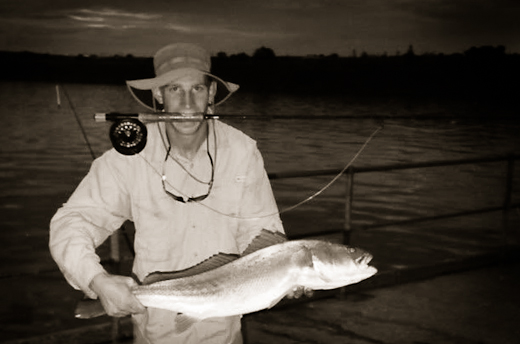
My first mulloway on fly back in 2003

Taking my mind off the Flywater Exposed project for the past few weeks has been of all thing some bait fishing. It's not often these days that I fish with bait, however in a few select locations or circumstances it is the best option. I won't be going on about bait fishing in many posts, and the reason for this post is actually fly fishing related if you will bear with me.


The current situation is one I hadn't seen much of over the last few years as I had been busy with other things. The target species was mulloway, and schools of them move within range of a jetty in a popular Yorke Peninsula (South Australia) town each summer. As these schools are visible to those with good polarised glasses, they are a great sight casting proposition. Unfortunately over the last 10 years or so, these schools have become common knowledge and even on weekdays there are enough people fishing for them that fly fishing is not an option 99% of the time. So that brings me to the bait fishing part. Such visual fishing can't be passed up, but even lure fishing is difficult when a combination of sinkers, and floats are raining down on the school from all angles. So there I am with a spin rod and small live baits and fresh cut squid with a few mates. We caught some good fish. It's great fun, however none of these particular captures are overly memorable. 


Before this place gained popularity back around the time I started fly fishing seriously, when the fish were in range I was able to get a fly to the school. I caught two fish and lost another on fly, and I can most likely recount all of those hookups better that that of the bigger of the two fish I caught last weekend on bait despite the fact that those fly hookups were back in 2003! This brings me to the point of this post (finally). I picked up a copy of South Australian Angler yesterday and had a flick through while waiting to pay a bill. I haven't purchased a copy for years, but there were a few articles that looked interesting. One was about fishing for big mulloway, and the other was about South Australia's far west coast. I quite quickly realised that it might be not only fun, but add interest to those reading this blog if I plan a few lesser trips and doccument them here. The far west coast is extremely remote, and I thought that there is probably no better place to start than this wild part of my home state. I will also try and come up with some other Aussie adventures to do over the next few years while  planning for the big Flywater Exposed continues.


Unfortunately due to the crowds, fly fishing here is now rarely an option

So, how does it sound? The far west coast offers the opportunity to fish for monster mulloway up to 80lbs in deep surf gutters close to the shore - perhaps a heavy double handed fly rod will be taken along to attempt to catch one of them. I have never heard of a big mulloway taken from a South Australian surf beach on fly, so I would love to give it a go. Apart from the mulloway, there are plenty of other species to target on fly from the little tommy ruff, Australian salmon, snook, flathead and kingfish to name a few. I am thinking if planning can start now, this should come together in the summer of 2012/2013


You can find more about South Australian Angler here at their website www.saangler.com.au


My mate Gareth with another good fish caught on light spin gear and live bait