

Saturday, 2 March 2013
The Perfect Camera System - Part 3
Anyone going to guess which camera body I have chosen to go with? It's been mentioned in the blog before, but wasn't mentioned in the last post. I guess you could say the little poem I've written below is an announcement of the chosen camera body, and therefore the system that I will be using. For now I will simply leave you with it - more details on why in a later post, but since I've ordered two of these, two flashes, and 6 new lenses to go with them - I figured you may all be curious. So here goes....................

Monday, 4 February 2013
The Perfect Camera System - Part 2
 |
| A rocky, reefy ledge - Yorke Peninsula, South Australia |
As you may remember in Part 1, I went through my requirements for a suitable camera for the this project. Now I am going to concentrate on the finer details that separate each camera from one other. I was hoping to get to try at least some of these cameras before writing this, but unfortunately it did not work out that way. It was decided that a digital SLR with a full frame 35mm sensor was the ideal system. There are only 2 companies that come to mind that currently produce them, and have a wide enough range of lenses to cover both the work I will be doing on this project, and the other work that will be called of them for my other photographic work: Those two companies, not surprisingly are Nikon Canon, This is good in a way, as it means less options to look at, however after much deliberation, I am still struggling to make a decision..
As much as I would like to take the full size pro bodies such as the Canon 1DX and the Nikon D4, I will be upfront and say I don't think I can justify the cost - especially as I want 2 bodies and would prefer if they were both the same. They would be fantastic for my work here, however their added bulk and weight would not be in their favour. There are also some fairly recent offerings from both Canon and Nikon that look ok, but as I have narrowed it down to 2 already (well 3 actually as you will come to see shortly) I will cut to the chase and discuss them in more detail.
The Final Contenders
Well, from Nikon there is the D800, and to throw an extra into the mix there is also the D800E. The Canon 5D MkIII, is the other option. Some people will say stick to Canon since I already own some fairly nice Canon glass, while others would argue that the D800 and D800E with their amazing 32mp Sony Exmor sensor is a much better choice. I prefer to weigh everything up in terms of what system will be best suited for my needs. To be honest I know I could very hap[pily live with either, but I see pros and cons with each. For the purpose of keeping this as short as I can, I will consider the 2 Nikons as one camera for now as deciding between the two variants will be something I do before purchasing if I decide to go Nikon. For those that don't know, the only difference between the D800 and D800E is the fact that Nikon has essentially offered the same camera both with and without an optical low pass filter (anti aliasgin filter). The "E" version does not have this filter, and therefore it does not blur the image at all before recording it on the sensor. It means the camera is capable of extra sharpness, however as a trade off moire (or pattern noise) can sometimes be an issue.
The Deciding Factors
For me, what I currently own has no bearing on my decision as I will be selling all of the equipment I already own to start with a fresh kit. I will be buying the new gear in the next month or so, and therefore need to make my decision fairly soon. Basically I am looking at what both camera systems offer me. I have to say that from a lens perspective, I am strongly leaning towards Canon for a couple of reasons. From a sensor perspective however, Nikon wins hands down. It has higher resolution, and great dynamic range, and the ability to pull shadow detail out without introducing colour noise. All of this is a big plus to Nikon, the only thing that the Canon has in its favour as far as sensors go is better skintones. Plenty of Nikon shooters and their high end clients are satisfied with portraits shot on Nikon, so the skintones thing isn't a deal breaker for me. Well, for the Nikon, that's about it! Atofocus capability finally seems to be in Canon's favour (at least when selectiong from the higher end bodies), and also Canon's impementation of live view.
Canon has a few special lenses that I really would like to own, the TS-E17mm f4L is one of them. I think it would make a fantastic landscape lens and I would like to use it for some other work too. Nikon still has nothing that compares to it. The Stunning TS-E 24mm f/3.5L II is another, however this time Nikon does have a competitor for it in the PC-E 24mm f/3.5D ED. Unfortunately for it, it sounds like the Canon may be slightly superior optically, and is capable of a greater range of movements. The Canon 85mm f1.2L II is another particularly legendary lens that I have wanted to own for some time
Now, I'm not sure that the 85mm f1.2L would make it in the bag on the flywater Exposed journey due to it's size and weight, but the two TS-E lenses would be put to work shooting a lot of landscapes. If I went Nikon, then I think I would just buy the 14-24mm f/2.8G ED, which would no doubt struggle slightly in the corners for sharpness, and not offer the creative possibilities, ability to keep vertical lines straight, or extra depth of field offered by the TS-E or PC lenses listed above.
The other main lenses I will be considering at this stage are pretty basic. the latest 24-70mm f/2.8 and 70-200mm f/2.8 (IS/VR) zooms from either company. All sound pretty good as far as zooms go, so I won't even bother weighing these into the equation. Other than that a decent macro is about it and things are pretty much covered. The Canon 100mm f/2.8L Macro IS is the pick for me there, while from what I have heard the Nikon Micro 60mm f/2.8G ED is the one to pick.
So there we have it - I'm stuck! The amazing high resolution 32mp, high quality files the Sony sensor equipped Nikon is capable of producing, with some very nice lenses, or the still highly capable Canon 22mp senor with its accompanying superior focusing capabilities both with live view and through the viewfinder, plus those specialiust lenses that come at a hefty price. I know I can't make a wrong decision, but it's tough. Stay posted as I decide once and for all over the next few weeks.
Saturday, 5 January 2013
Welcome to 2013
Firstly I would like to say I hope everyone had a wonderful Christmas and a Happy New Year. I know this post is later than it should be, but I have been back at work, and when not here had a lot of other things to sort out. You know how things can get at this time of year! Even saw my first shark bite wound (will keep that story for an upcoming post).
I thought I would make my first post for 2013 a bit of an overview of what I hope to achieve this year. Firstly, if you have read the about page, you may have noticed I have never attempted to get an artice or my images published in any of the flyfishing publications. Well, by the end of 2013, I am hoping that you will be able to open one or more of them up and see my work in print. Of course when that happens I will keep you informed.
As for the exciting bit, the adventure and flyfishing - well, I have a number of trips in mind. The main one as far as I am concerned is Exmouth in Wester Australia. I hope to spend about 3 weeks there and am hoping to spend a few days fishing with guides and a lot of time exploring the flats with a fly rod in hand. If all goes well, I would love to catch my first bonefish and permit, as well as a heap of other firsts on this trip. Those two species will probably require the help of Brett Wolf of True Blue Bonefish.
Here are a couple of videos that are from the True Blue Bonefish site.
Ok, so that's Exmouth. I also have at least 2 and possibly 3 other major trips planned. The idea is to make my first trip to Tasmania before the year is out, and also another visit to New Zealand where I may make the trip to the North Island for the first time. If opportunity allows I would also like to head up north to the top end and spend some time both in Darwin and in other more remote parts of the Northern Territory.
Apart from trips, I will hopefully be purchasing some new camera gear over the coming months (I'm still researching and having some difficulty making a final decision, hence the lack of Part 2 of my "Perfect Camera System" post. Fear not, after a little more thought Part 2 will come. I will also be buying some lighting equipment if all goes to plan, but that isn't overly relevant, however it will allow me to get better shots of products that I photograph and present on the blog.
So there is a bit of an idea of what will be happening. Obviously I will continmue to fish in more local waters as well, and will hopefully have a heap of fishing stories, and lots of relevant "other stuff" to present to you all. It certainly will be a busy year!
If you are interested in fishing for the bonefish and permit of Exmouth, despite not having met him myself, I would not hesitate to reccommend Brett Wolf as he has a fantastic reputation. Check out his site www.truebluebonefish.com.au for details and heaps of photos or contact him via email brett@truebluebonefish.com.au
I thought I would make my first post for 2013 a bit of an overview of what I hope to achieve this year. Firstly, if you have read the about page, you may have noticed I have never attempted to get an artice or my images published in any of the flyfishing publications. Well, by the end of 2013, I am hoping that you will be able to open one or more of them up and see my work in print. Of course when that happens I will keep you informed.
As for the exciting bit, the adventure and flyfishing - well, I have a number of trips in mind. The main one as far as I am concerned is Exmouth in Wester Australia. I hope to spend about 3 weeks there and am hoping to spend a few days fishing with guides and a lot of time exploring the flats with a fly rod in hand. If all goes well, I would love to catch my first bonefish and permit, as well as a heap of other firsts on this trip. Those two species will probably require the help of Brett Wolf of True Blue Bonefish.
Here are a couple of videos that are from the True Blue Bonefish site.
Exmouth Bonefish
Exmouth Permit
Apart from trips, I will hopefully be purchasing some new camera gear over the coming months (I'm still researching and having some difficulty making a final decision, hence the lack of Part 2 of my "Perfect Camera System" post. Fear not, after a little more thought Part 2 will come. I will also be buying some lighting equipment if all goes to plan, but that isn't overly relevant, however it will allow me to get better shots of products that I photograph and present on the blog.
So there is a bit of an idea of what will be happening. Obviously I will continmue to fish in more local waters as well, and will hopefully have a heap of fishing stories, and lots of relevant "other stuff" to present to you all. It certainly will be a busy year!
If you are interested in fishing for the bonefish and permit of Exmouth, despite not having met him myself, I would not hesitate to reccommend Brett Wolf as he has a fantastic reputation. Check out his site www.truebluebonefish.com.au for details and heaps of photos or contact him via email brett@truebluebonefish.com.au
Monday, 24 December 2012
Night Photography - Part 2
The Night Time Fun Continues
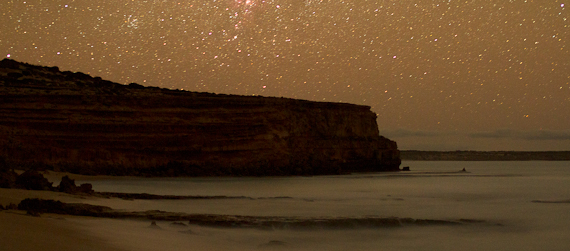
Shooting at night with only the moon and stars as a light source is certainly fun, and a challenge. As mentioned in part 1, this was all experimental for me. Essentially I played around with shutter speeds, apertures, and focusing and simply reviewed the results on my cameras LCD screen. I made adjustments based on what I could see. Being so dark, I basicallty relied on wider apertures ranging from f1.4 -2.8 on my 50mm lens, and with my wide angle zoom unfortunately I was limited by the maximum aperture of f4. Essentially I shot almost every shot at 30 seconds no matter the aperture as this was the longest available on my camera without using a remote shutter or cable release which I didn't have with me. To adjust for the different apertures I varied the ISO settings between ISO 1600 and ISO 6400. It may be a little disappointing to read after the long wait for part 2, but that is essentially it. Use a wide aperture, a slow shutter speed, and the lowest ISO setting that allows enough light to capture the image you are after. To be honest, the experimentation is quite rewarding in itself. On some shots I also used the in camera noise reduction which helped a little, however it essentially doubles the length of the exposure. The process reminds me of developing film in a darkroom. Immediately after each image is captured, you sit and wait for the capture to end, and then an image emerges on the LCD. Ok, not quite the same, but when you are starting out what you get can be quite a mystery until you see it.
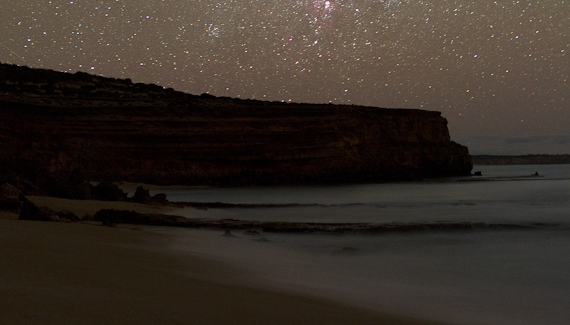
One other variable that you can play with in camera or later on the computer if you shoot in RAW as I do is the white balance. As you can see below, a different white balance setting is used in an image similar to the one at the top of the post which entirely changes the mood.
 |
| Starry Seascape |
Shooting at night with only the moon and stars as a light source is certainly fun, and a challenge. As mentioned in part 1, this was all experimental for me. Essentially I played around with shutter speeds, apertures, and focusing and simply reviewed the results on my cameras LCD screen. I made adjustments based on what I could see. Being so dark, I basicallty relied on wider apertures ranging from f1.4 -2.8 on my 50mm lens, and with my wide angle zoom unfortunately I was limited by the maximum aperture of f4. Essentially I shot almost every shot at 30 seconds no matter the aperture as this was the longest available on my camera without using a remote shutter or cable release which I didn't have with me. To adjust for the different apertures I varied the ISO settings between ISO 1600 and ISO 6400. It may be a little disappointing to read after the long wait for part 2, but that is essentially it. Use a wide aperture, a slow shutter speed, and the lowest ISO setting that allows enough light to capture the image you are after. To be honest, the experimentation is quite rewarding in itself. On some shots I also used the in camera noise reduction which helped a little, however it essentially doubles the length of the exposure. The process reminds me of developing film in a darkroom. Immediately after each image is captured, you sit and wait for the capture to end, and then an image emerges on the LCD. Ok, not quite the same, but when you are starting out what you get can be quite a mystery until you see it.
One other variable that you can play with in camera or later on the computer if you shoot in RAW as I do is the white balance. As you can see below, a different white balance setting is used in an image similar to the one at the top of the post which entirely changes the mood.
 |
| White balance can make a big difference |
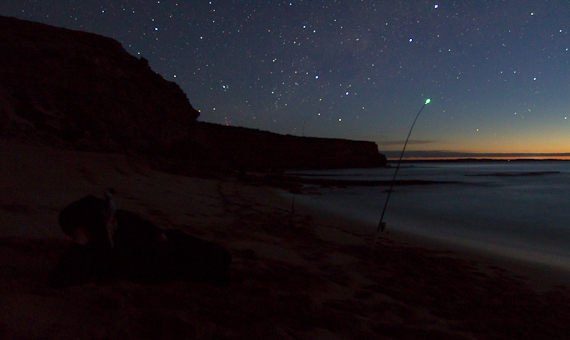 |
| Another Idea is to shoot as the stars are appearing right after the sun goes down. |
Of course if you want to take things further you can experiment in mixing flash or other artificial light sources with these types of shots. As you will see from the few examples below, I have a lot of work to do in this department. It requires a lot of thought. In particular about what will be behind the flash lit subject if it's human, as during the remaining part of the exposure they will no doubt move to some extent. Gives me a lot to think about next time anyway. Hope you have found these images interesting.
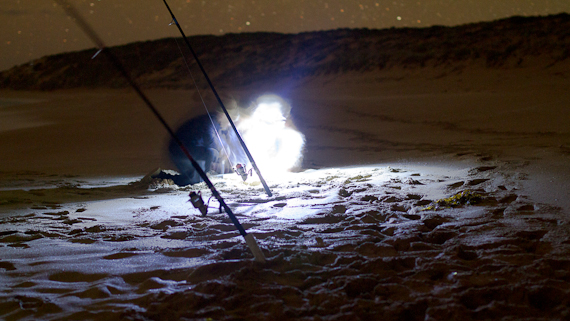 |
| From memory it was only a headlamp providing the artificial lighting in this shot |
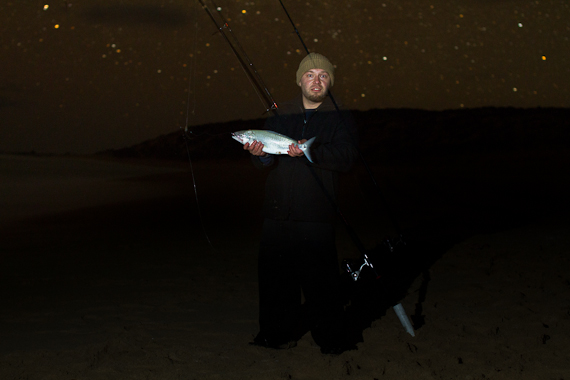 |
| Note the fishing rod behing his head! Canon 580EXII off camera provided the illumination |
Thursday, 11 October 2012
Night Photography - Part 1
 |
| Waiting for a bite at night |
Getting Creative in the Dark
Most people put their cameras away when out fishing once the sun goes down unless taking happy snaps of a significant catch. I too was mostly guilty of this in the past. I had made a few attempts once or twice at getting an interesting shot at night, and have had varied success. On an overnight trip to the bottom of South Australia's Yorke Peninsula last weekend, I carried a tripod in to shoot some wide angle landscapes. When I opened my camera bag, to my horror I discovered that in my haste I had not swapped the len which was on my 7D over for the wide angle zoom. Instead of having a 17-40mm and 70-200mm with me, I had no focal length shorter than the Sigma 50mm f1.4 which was on the camera body. The 50mm focal length is considered a "normal" lens on 35mm film and full frame digital. As the 7D has a cropped frame sensor, the lens angle of view gives a short telephoto perspective, and was therefore useless for the types of images I had in mind. I did shoot a few frames of the cliffs that you can see in the image above as the sun was setting, however my efforts were a little rushed and half hearted as I did not have the lens I had planned to use.
Since I had carried the tripod in, I figured I had better get more than a few minutes use from it, so after the sun set, the sky darkened, and the cloud cover mostly disappeared to reveal the stars; out came the camera again. Using the tripod, a slow shutter speed, and the fast aperture of the 50mm f1.4 lens, I did my best to roughly compose through the viewfinder (no preview image was available on the cameras LCD screen in liveview mode as it was much too dark). I then turned on liveview and used the electronic level to try and get the horizon relatively straight. I made a number of images using this and similar techniques. I am the first to admit they could be improved, but for me this was a whole new idea. In Part 2 I will go through how I went about experimenting that night, and will share a few more images that were created as a result.
Saturday, 29 September 2012
Back to it on Grand Final Day!
 |
| Goal Posts |
Firstly I would like to apologise for the lengthy delay in this post, and of course the lack of posts over the last 6 months. To those who know me personally, you will understand I have had other things that needed dealing with in my personal life. To those who don't, I greatly appreciate your patience - Thank you all.
My Australian readers will know that it is AFL Grand Final Day today. As I type this, the vast majority will most likely be watching the big game. Not me though, it has never really been my thing. So this seems as good a time as ever to get back to what is important to me - the Flywater Exposed project!
I know from what I have been told that some of you had been eagerly awaiting part 2 of The Perfect Camera System. It is in the works and will hopefully be coming quite soon. I started writing it quite recently, and then noticed that a number of interesting new full frame cameras have been announced. Since it will be a little while until I get full details about how good they actually are, I though it may be best to hold off until I can include them in the post. I have also decided to try and push Flywater Exposed further now that I am back. I will be talking to a few local camera stores and attempting to get my hands on some of these cameras for review, and so that I can give my personal views on what I like and dislike about them. To my mind this would be much more useful both to you and to myself than me simply reporting on what other people say about these cameras.
Thanks again for your patience. A number of new posts will be up over the coming weeks.
Tuesday, 6 March 2012
The Perfect Camera System - Part 1

As a major part of the Flywater Exposed project revolves around producing a body of high quality photography, it probably will not be a surprise to anyone that photographic equipment is an important part of what will be taken on the journey. I decided almost immediately that I would take only one system and the necessary backup gear in case of failure. I don't plan on being anywhere near a camera store, so everything will have to come with me. Selecting a system was the next step, and it made most sense to stop and think about what I need from my camera. Of course, to do this I had to think about what my actual requirements were, as opposed to what I would like.
It was important to define the necessities, the things required as a prerequisite for a camera to even be considered. I decided there were 4 things that were absolute musts. The first thing to come to mind was reliability, secondly, control, thirdly a range of suitable lenses and accessories, and last but not least - image quality.
To me, a reliable camera for outdoor work should be built strong on a tough metal chassis and have a reasonable level of weather sealing. Straight away, this rules out all the cheaper consumer cameras except a handful of compacts, some of which are totally waterproof and highly shock proof too.
Control is the next thing which is important to me. From the time of capture, right through until the point the prints roll off the printer I must be able to control things. At capture, I like to make my own decisions on exposure, depth of field, shutter speeds and where in the image the focal point lays. Once the image makes it from the memory card to the computer, I insist on "developing" it in a RAW converter rather than have the camera do this conversion it's own way in camera. This counts out those waterproof, shockproof compacts that I mentioned above.
When it comes to image quality, what I require is enough resolution to shoot landscapes and print them at a reasonable size at exhibition quality. If I can produce a 16x24 inch print that has enough detail to keep me happy, then it will be fine. Of course a bigger print would sometimes be even better. If the camera can capture a reasonable amount of dynamic range, produces pleasing colours, and can manage shooting without flash in low light at relatively high ISO settings - then it will produce the image files I am looking for.
Lastly, a range of lenses needs to be available that will cover all the shooting I am likely to do. The plan is to shoot a lot of landscapes, so therefore lenses that perform well from corner to corner will be highly regarded. If they have tilt and shift functionality, so much the better. As a bonus, lenses with movements allow easy stitching for making higher resolution prints. I also plan to shoot portraits of the locals, so some mid range focal lengths with fast apertures would be nice if they fit in the bag. A good macro lens is also essential for capturing some small but important details. For all of these types of shooting I prefer prime (fixed focal length) lenses. Of course as backup, and for the less critical shots that are less likely to be displayed as large exhibition prints, a few high quality zooms would definitely be worth having in the bag. A good flash system certainly wouldn't go astray either, allowing images that could not otherwise have been made to be produced.
The Ideal Camera Format
What I have decided so far is that a full frame 35mm sensor digital SLR is the camera format that makes the most sense. There are a few around with the build quality and reliability that I am after with sensors packed with high quality pixels. Of course there are also some sub full frame cameras that would work, including the Canon 7D which I currently own, however I prefer the wide angle options afforded by the larger sensor cameras. If I was mostly shooting wildlife, that may be a different matter.
Part 2 will focus on the nitty gritty details of selecting an actual camera from the contenders, and give some details about some of the options that are available.
Subscribe to:
Posts (Atom)